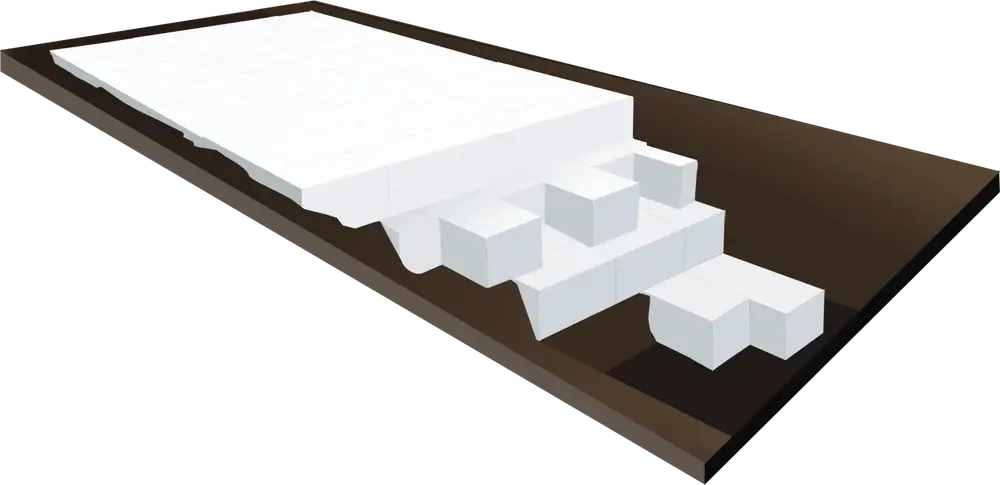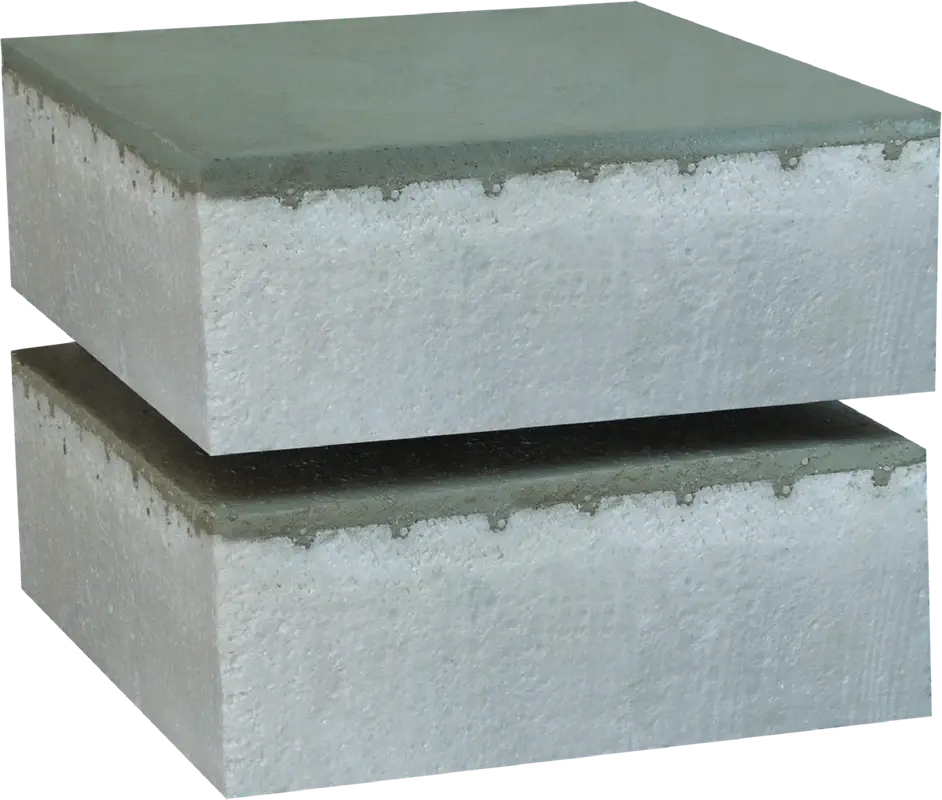
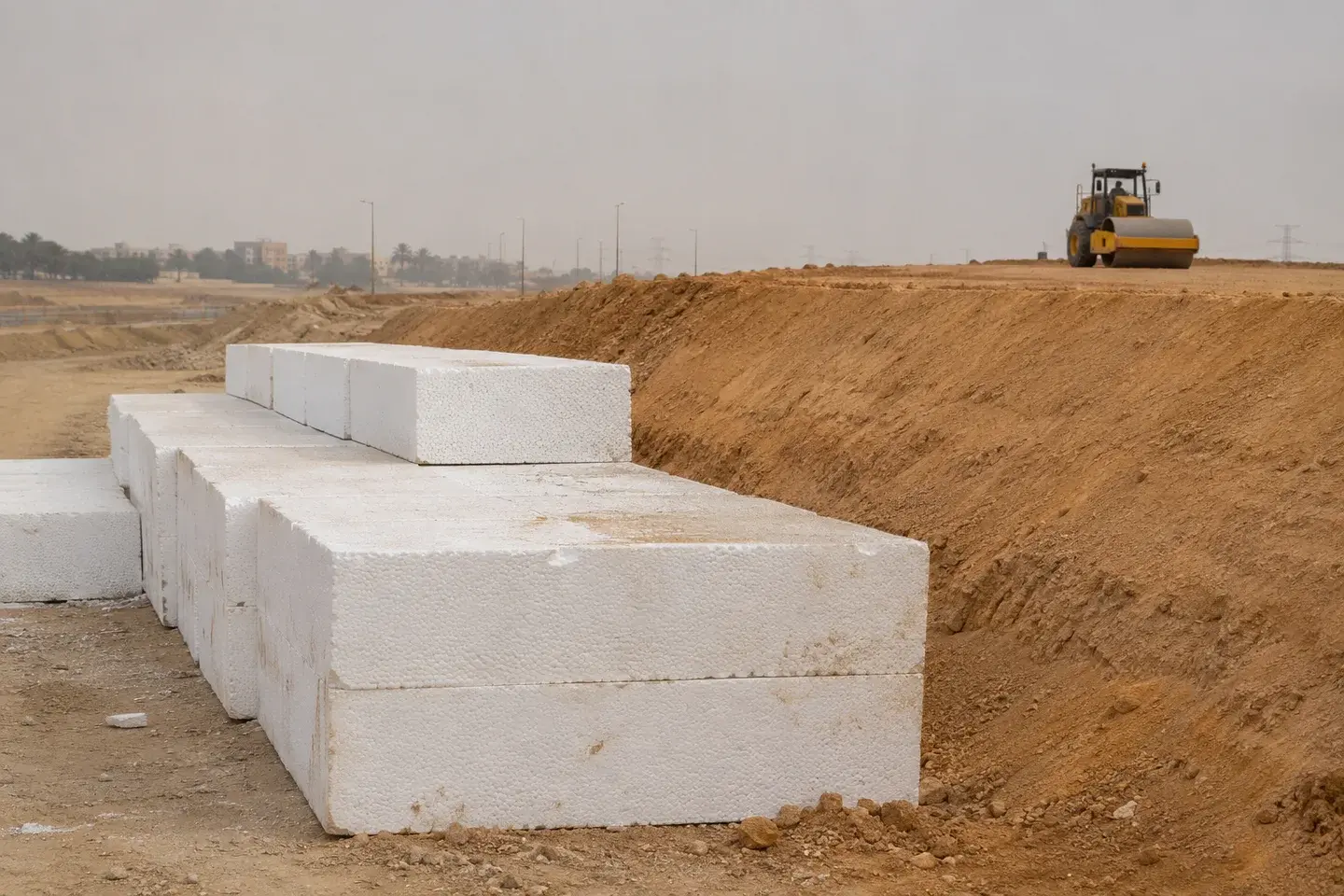
 White geofoam blocks beside a soil embankment and a road roller
Introduction
Imagine raising a highway grade over soft ground—should you pile on hundreds of tons of compacted soil, or use an engineered fill material that weighs a fraction as much?
In road and bridge construction, selecting a fill material is about far more than the unit price per cubic meter. Fill dead weight directly governs subgrade stress, long-term settlement risk, and lateral loads acting on adjacent structures.
That is where Chema Geofoam by Chema Foam comes in as a high-performance lightweight geotechnical alternative to conventional earth fill.
Yet is EPS geofoam always better than traditional soil? Let's compare both options by the numbers.
What Is The Difference Between Chema Geofoam And Traditional Soil Fill?
Chema Geofoam consists of rigid expanded polystyrene (EPS) blocks engineered specifically for lightweight geotechnical fill applications.
Traditional earth fill relies on select soils—such as sand or granular aggregates—placed and compacted in lifts to achieve the specified dry density.
The core difference between the two systems lies in dead weight, installation methodology, and the resulting stress imposed on the underlying foundation soil.
Chema Geofoam Vs. Traditional Soil Fill: Comparison Table
| Comparison Criteria | Chema Geofoam | Traditional Soil Fill |
|---|---|---|
| Approximate Density | Depends on specified EPS grade | 1,800–2,200 kg/m³ |
| Self-Weight (Dead Load) | Ultra-low | High |
| Construction Method | Placement of prefabricated blocks | Spreading and compacting soil lifts |
| Compaction | No block compaction required | Requires heavy compaction and density testing |
| Impact on Soft Soils | Dramatically reduces embankment loads | Imposes substantial overburden stress |
| Installation Speed | Often faster on site | Depends on earthmoving fleet and site conditions |
| Groundwater Resistance | Requires buoyancy analysis and anchorage design | Depends on soil permeability and drainage |
| Material Unit Cost | Typically higher per m³ | Typically lower per m³ |
Refer to the Chema Geofoam technical specifications for exact density and compressive resistance values by grade.
By The Numbers: What Happens When You Fill 100 M³?
A simple mass calculation shows why self-weight can completely reshape a geotechnical design.
Consider a project requiring 100 m³ of embankment fill, assuming compacted soil at 1,800 kg/m³ versus EPS geofoam at 20 kg/m³:
| Parameter | Traditional Soil | Chema Geofoam |
|---|---|---|
| Fill Volume | 100 m³ | 100 m³ |
| Assumed Density | 1,800 kg/m³ | 20 kg/m³ |
| Total Mass | 180 tons | 2 tons |
| Mass Difference | — | Approx. 98.9% lighter |
In this illustrative example, a 180-ton soil embankment mass is replaced by roughly 2 tons of geofoam.
Note that this figure excludes protective slabs, load-distribution layers, and pavement structure—and does not eliminate live traffic loads.
Why Does Chema Geofoam Excel Over Soft Soils?
Sometimes the smartest way to control settlement isn't just improving the ground—it's removing the weight placed on top of it.
Placing conventional earth fill over soft, compressible clay often triggers excessive consolidation settlement, forcing costly ground-improvement works or lengthy preloading waiting periods.
Chema Geofoam drastically lowers embankment dead loads, helping curb fill-induced settlement and maintain structural stability within design tolerances.
This advantage is particularly valuable at bridge approaches and in tight corridors adjacent to existing structures.
4 Practical Advantages Of Chema Geofoam
1. Reduced Vertical and Lateral Loads
Geofoam's ultra-low unit weight minimizes vertical overburden pressure on weak subgrades and, when properly engineered, can significantly reduce lateral earth pressures behind retaining walls.
2. Accelerated Construction Schedules
Every day of delay on a highway project can cost far more than the unit price gap between fill materials.
Geofoam arrives on site as ready-to-place blocks, eliminating lift-by-lift compaction and consolidation waiting periods.
3. Easier Transport and Site Handling
EPS blocks can often be handled with lighter equipment or manual crews, provided they are properly ballasted or secured against wind uplift during installation.
4. Geometric Design Flexibility
Chema Foam supplies Chema Geofoam in varied block dimensions, making it straightforward to fit constrained footprints or complex embankment geometries.
When To Choose Geofoam Vs. Traditional Soil Fill
Not every project requires geofoam—and not every subgrade can safely carry conventional earth fill.
| Project Scenario | Option Worth Evaluating |
|---|---|
| Roadways over soft, compressible soils | Chema Geofoam |
| Bridge approaches prone to differential settlement | Chema Geofoam |
| Backfill behind retaining walls to cut lateral pressure | Chema Geofoam |
| Grade raising over weight-restricted structures | Chema Geofoam |
| Routine embankments over competent, firm ground | Usually traditional soil fill |
| Budget-driven fills with no load constraints | Usually traditional soil fill |
| Sites with high groundwater tables | Full buoyancy and protection study before specifying geofoam |
Is Chema Geofoam More Economical Than Conventional Fill?
True project cost isn't the price per cubic meter—it's the total cost of delivering the complete structure.
While EPS geofoam typically carries a higher material cost than soil, it can generate meaningful overall savings by reducing ground-improvement works, heavy compaction equipment, construction duration, and structural reinforcement requirements.
A rigorous cost comparison must account for supply, installation, protective load-distribution layers, drainage, long-term maintenance, and geotechnical risk.
For that reason, no fixed percentage of savings can be assumed without a project-specific engineering estimate.
Key Engineering Precautions Before Specifying Chema Geofoam
Despite its advantages, EPS geofoam must be engineered to satisfy compressive resistance and long-term creep limits, with loads properly distributed through dedicated protective layers.
Designers must also evaluate buoyancy uplift in areas with elevated groundwater, and protect the blocks from open flames, hydrocarbon solvents, and prolonged UV exposure.
It is equally important to note that Chema White EPS serves different thermal and general applications, and Chema Block is engineered for hollow-core (hourdi) slab systems—neither is a direct substitute for Chema Geofoam's geotechnical specifications.
Conclusion: Chema Geofoam—Less Weight, Higher Engineering Efficiency
On roads, bridges, and soft-ground sites, heavier fill does not automatically mean a stronger or more reliable embankment.
With Chema Geofoam by Chema Foam, engineers can dramatically cut dead loads and streamline construction wherever lightweight geotechnical fill adds value.
Request a quote from Chema Foam or consult our engineering design team to select the right geofoam grade for your project.
This comparison draws on official Chema Geofoam product documentation and U.S. Federal Highway Administration (FHWA) guidance on conventional embankment densities, EPS geofoam applications, buoyancy, protection, and lifecycle cost.
Chema Foam+3
Mass Of 100 M³ Of Fill Material
- Traditional Soil Fill: 180 tons
- Chema Geofoam: 2 tons
Illustrative example: soil at 1,800 kg/m³ vs. geofoam at 20 kg/m³; excludes protective and pavement layers.
Figures are illustrative and do not represent measured values from a specific project.
Product-specific design and application must follow approved project specifications and current technical documents.