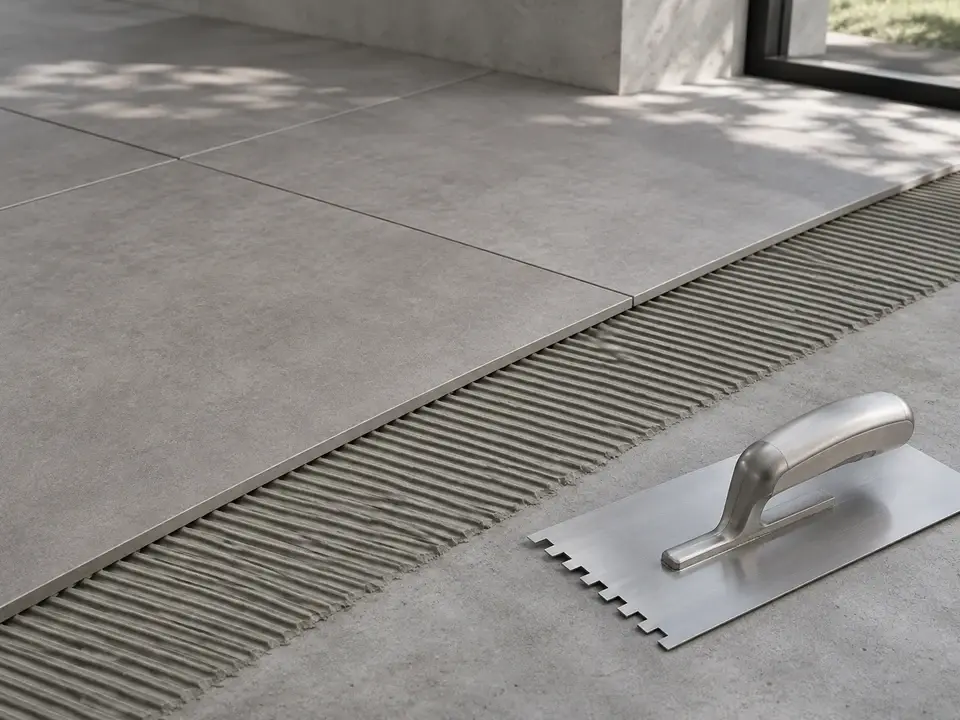
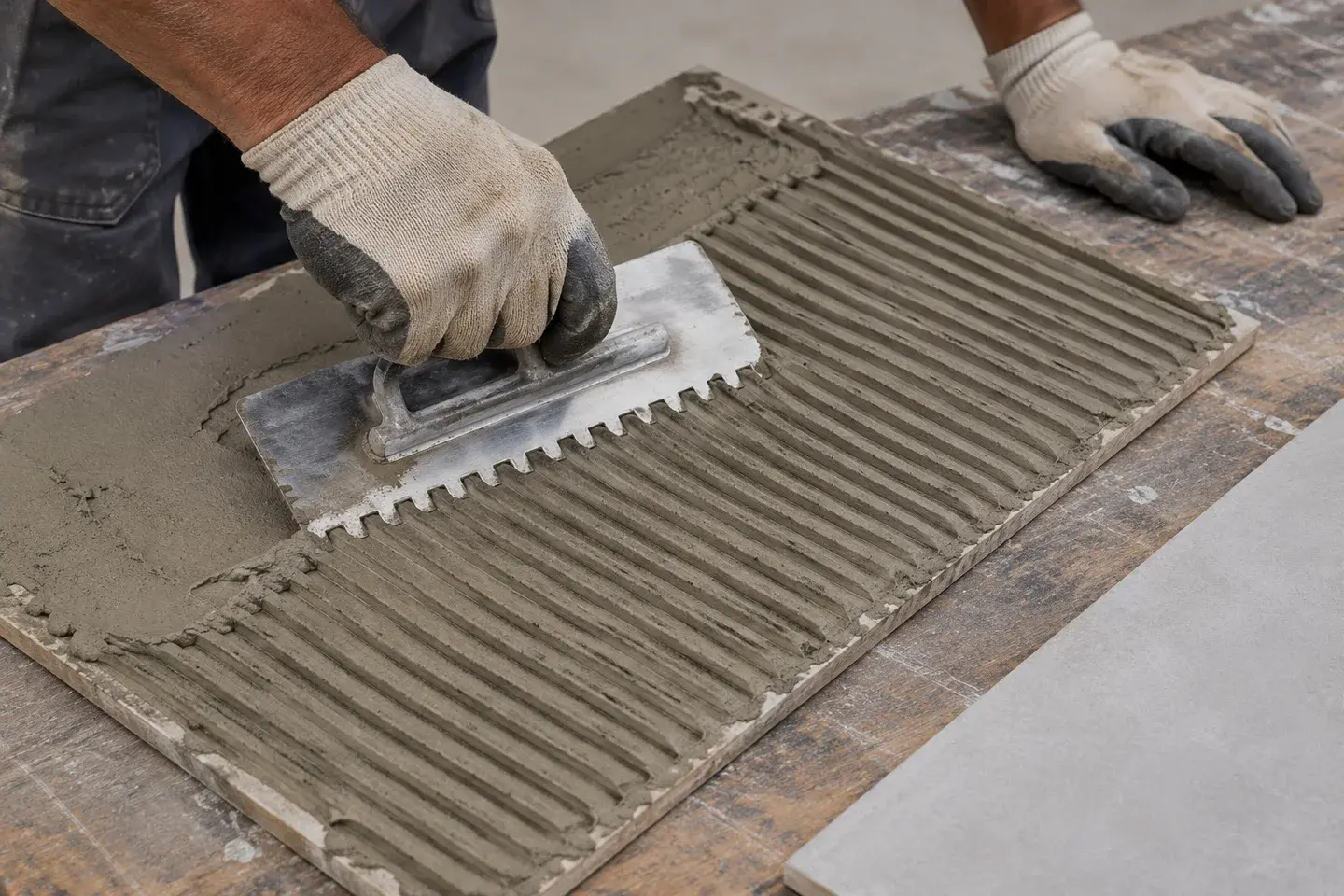
 Tile adhesive combed onto a porcelain tile with a notched trowel
Introduction
Have you ever invested in premium ceramic or porcelain tiles, only to end up with debonding or hollow-sounding spots after installation?
The culprit isn't always tile quality or workmanship—often, the root cause is specifying an adhesive that doesn't match the tile type or site conditions.
That is why choosing the right ceramic and porcelain tile adhesive is far more than a minor finishing detail; it directly governs installation quality and long-term durability.
To meet these demands, Chema Foam offers Chema Adhesive 101 and Chema Adhesive 102—specialized cementitious tile adhesives engineered to deliver the right performance tier for every project.
What Is Chema Adhesive?
Chema Adhesive is a ready-to-mix cementitious tile adhesive formulated from cement, graded aggregates, and performance-enhancing additives to ensure reliable bond strength between the tile and substrate.
It is easy to mix and comb onto substrates using a notched trowel, offering controlled workability and slip resistance during installation.
The range is available in two primary grades that differ in bond strength and performance characteristics according to the European standard EN 12004.
The key question, however, is: can you use the same adhesive for both ceramic and porcelain tiles?
The Difference Between Chema Adhesive 101 And Chema Adhesive 102
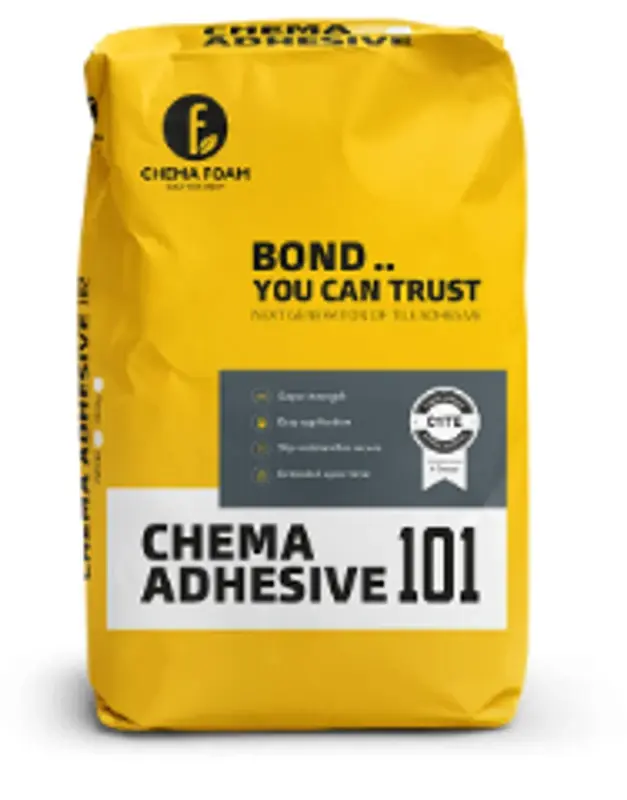
Chema Adhesive 101: A Practical Solution for Interior Ceramic Tiles
Chema Adhesive 101 is designed for bonding ceramic tiles to interior cementitious walls and floors.
Classified as C1TE under EN 12004, it offers effortless mixing and troweling, an extended open time, and reduced slip during vertical installation.
It is a dependable choice for standard interior ceramic tiling projects whose performance requirements align with its classification.
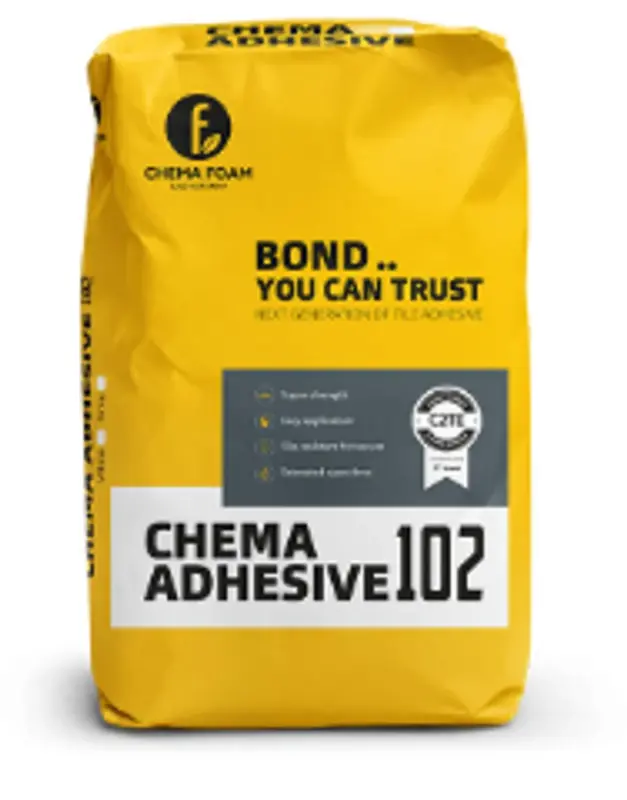
Chema Adhesive 102: Enhanced Bond Strength and Higher Deformability
Chema Adhesive 102, on the other hand, is an improved cementitious adhesive rated C2TES1, engineered for more demanding installations.
It is suited for fixing ceramic, porcelain, marble, and selected insulation boards in both interior and exterior applications that fall within its technical specifications.
It delivers enhanced bond strength even after water immersion and heat aging, while its S1 deformability class helps accommodate limited movement within the tiling assembly.
What Do C1TE And C2TES1 Classifications Mean?
The letters printed on an adhesive bag aren't just technical jargon—they are essential performance indicators that help engineers specify accurately.
- C: Cementitious adhesive.
- 1 or 2: Adhesion performance class; C2 provides higher bond strength than C1.
- T: Slip resistance for vertical applications.
- E: Extended open time after spreading the adhesive.
- S1: Deformable adhesive within standard testing limits.
Accordingly, the distinction between Chema Adhesive 101 and 102 goes well beyond price—it reflects a clear difference in mechanical performance and suitable applications.
Key Advantages Of Chema Adhesive
A great tile adhesive doesn't just hold a tile in place during installation—it sustains the required bond strength throughout the building's service life.
The Chema Adhesive range offers several core benefits:
- Verified, tested bond strength tailored to each product grade.
- Straightforward mixing and application with standard tiling tools.
- High slip resistance during tile placement.
- Extended open time for greater flexibility on site.
- Clear grade selection based on tile type and exposure conditions.
- Convenient 20 kg bag packaging.
Keep in mind that actual on-site bond strength also depends heavily on proper substrate preparation, accurate water-to-powder ratios, and sound application technique.
Project Applications Of Chema Adhesive
Applications span residential apartments, commercial developments, and large-scale engineering projects.
Chema Adhesive 101 is ideal for interior ceramic tile installations over sound cementitious substrates.
Chema Adhesive 102 is suited for porcelain and ceramic tiling in bathrooms, kitchens, and select exterior areas when installed in accordance with system guidelines.
It can also be used as part of the installation system for Chema XBoard panels, as well as certain FOAMINA facade architectural mouldings applications, with mechanical fixing applied wherever specified.
How To Apply Chema Adhesive Properly
Even the highest-grade tile adhesive can fail if it is mixed or applied incorrectly.
Start by thoroughly cleaning the substrate to remove dust, oils, and loose or friable material, ensuring the surface is level, sound, and stable.
Next, mix each 20 kg bag with clean water according to the selected grade:
- Chema Adhesive 101: 3 to 3.5 liters of water.
- Chema Adhesive 102: 5 to 6 liters of water.
Mix mechanically until a smooth, lump-free paste is achieved, let the mix slake for about 10 minutes, and then stir briefly again before use.
Spread the adhesive with a notched trowel and press the tiles firmly into place to achieve full required coverage, taking care never to exceed the open time.
Published indicative coverage ranges from 3 to 6 m² per 20 kg bag, depending on substrate condition and application thickness.
Does Chema Adhesive Replace Waterproofing?
No. Even when a tile adhesive offers moisture resistance, it is never a substitute for a dedicated waterproofing system.
In wet areas such as bathrooms and swimming pools, the project may require a compatible waterproofing layer—such as Chema Proof 107—prior to tiling, once layer compatibility has been verified.
After the tiles are set, Chema Tile Grout can be used to fill the joints in accordance with the product's technical specifications.
Chema Adhesive By Chema Foam: Lasting Stability Starts With The Right Specification
Whether you are a finishing engineer, contractor, or property developer, selecting the right tile adhesive elevates execution quality and minimizes the risk of costly rework.
With Chema Adhesive 101 and 102 from Chema Foam, choose the performance grade engineered for your project.
Request a quote from Chema Foam and consult our technical team to identify the right adhesive for your tile type and service conditions.
Product-specific design and application must follow approved project specifications and current technical documents.